Why is 24 called twenty-four?
Why not two-four?
Usually, our children know that 24 is twenty-four, but they don’t understand why.
We have a term called Place Value.
Place Value gives each digit a different value depending on its position.
Let’s start with the two building blocks of two-digit numbers: tens and ones.
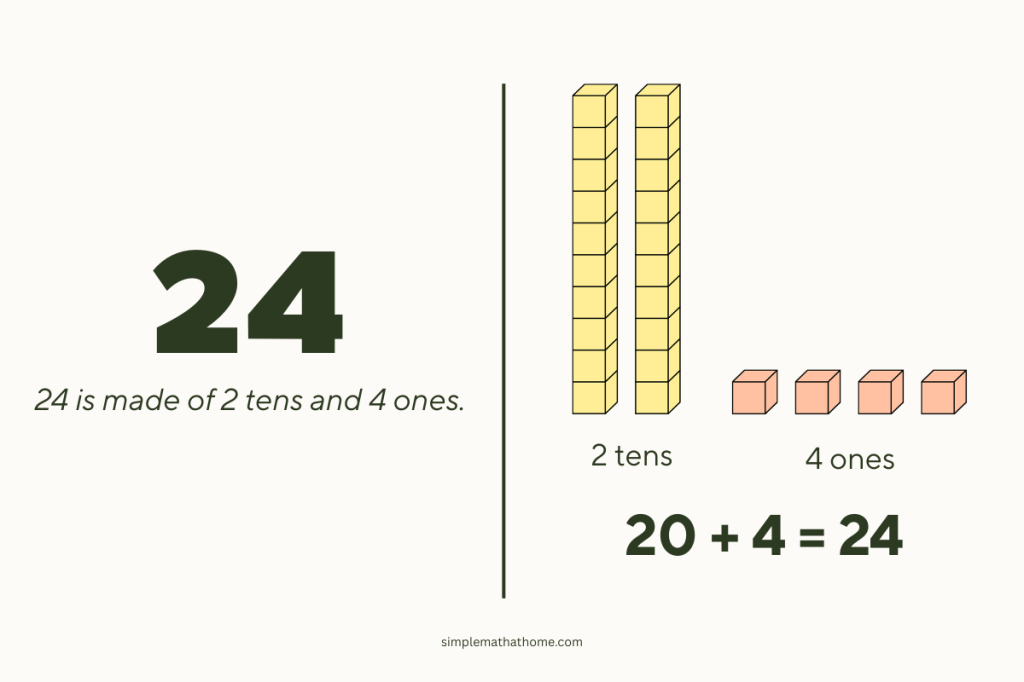
Try asking your child:
“How many tens are in 24?”
“How many ones?”
“So, how could we build 24?”
Then explain the answer.
Look at 24.
Ask:
“How many tens do you see?”
“How many ones?”
“What does the 2 represent?”
“What does the 4 represent?”
Then ask:
“Can we make 24 another way?”
This encourages your child to think about the number, rather than simply memorize an answer.
Try another number
Now try 36.
Ask your child:
How many tens are in 36?
How many ones?
What does the 3 represent?
What does the 6 represent?
Can you build 36 using tens and ones?
Can you write 36 another way?
Then:
36 = 30 + 6
And perhaps one more:
52 = 50 + 2
The digit doesn’t tell the whole story.
The 2 in 24 doesn’t simply mean “2.”
It means 2 tens, which is 20.
The 4 means 4 ones, which is 4.
What happens when we add a hundreds place?
Let’s see the picture below.
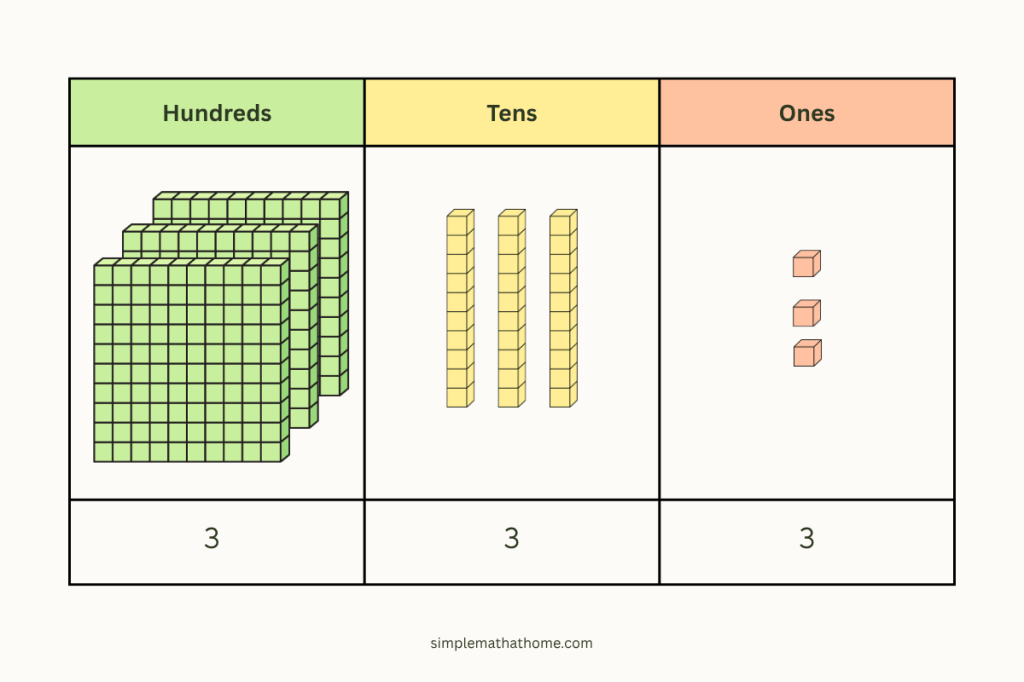
What do you see?
You see the digit 3 in each column in the bottom row.
Does that mean each of their value is 3? No.
The digit 3 in the hundreds place has a value of 300.
The digit 3 in the tens place has a value of 30.
Lastly, the digit 3 in the ones place has a value of 3.
When we put 300, 30, and 3 together, we get 333.
300 + 30 + 3 = 333.
3 hundreds, 3 tens, and 3 ones make three hundred thirty-three.
Summary
Place value is more than knowing what a number is called.
We want children to understand what each digit means because of where it is placed.
For example:
24 = 20 + 4
The 2 means 2 tens, and the 4 means 4 ones.
As numbers get bigger, the same idea continues:
333 = 300 + 30 + 3
The goal isn’t just for your child to get the right answer.
It’s to help them understand why.
Happy teaching! I hope math feels a little simpler at home.


Leave a comment